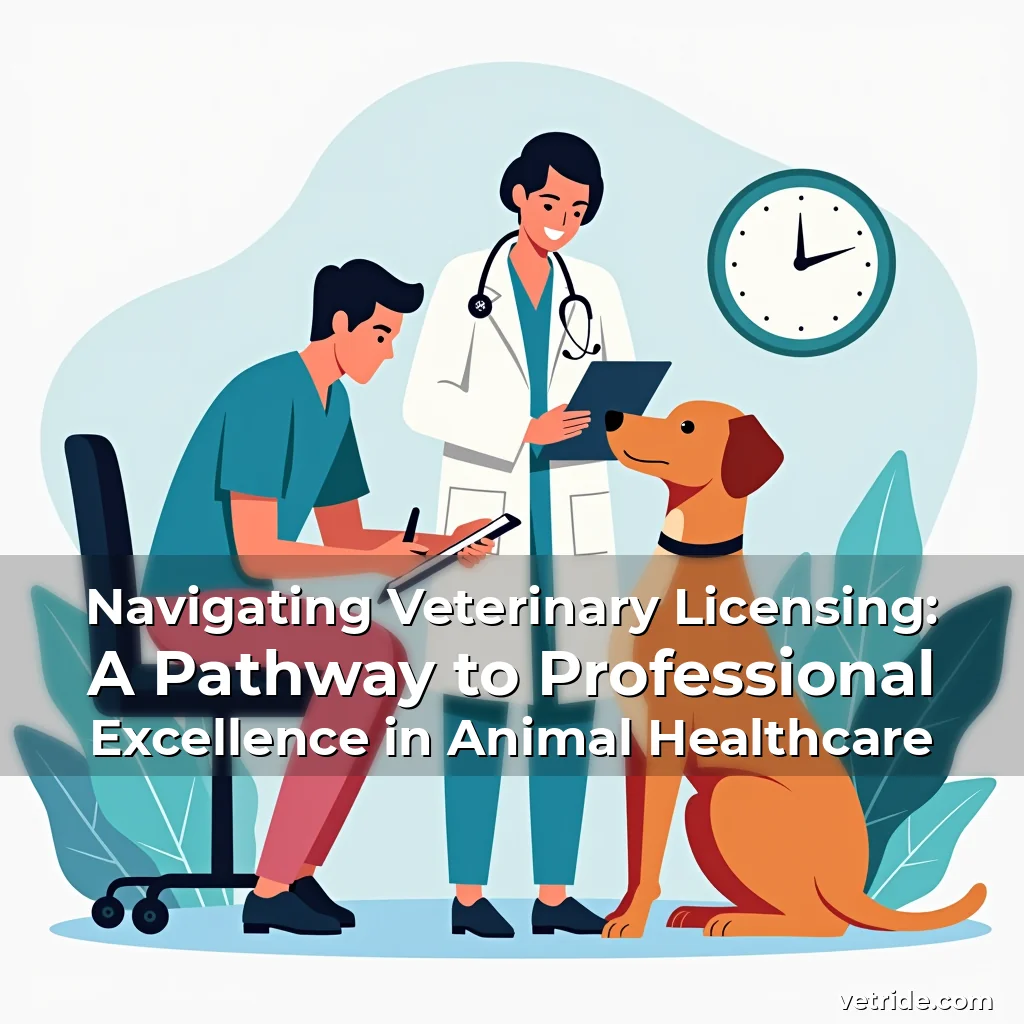
Navigating Veterinary Licensing: A Pathway to Professional Excellence in Animal Healthcare
Veterinary licensing serves as the cornerstone of professional credibility in animal healthcare, ensuring practitioners meet rigorous standards of competence and ethics. As part of the global veterinary community, including platforms like VetRide, understanding the intricacies of licensing is essential for both aspiring and practicing veterinarians. It acts as a gatekeeper, protecting public health while fostering trust in the profession.
The journey to obtaining a veterinary license involves meticulous preparation, adherence to regulatory frameworks, and ongoing commitment to education. From academic qualifications to clinical experience, every step is designed to uphold the integrity of the veterinary field. This guide explores these aspects in depth, offering insight tailored to those seeking to advance their careers or deepen their knowledge of licensing protocols.
The Foundations of Veterinary Licensing
Veterinary licensing establishes a legal framework that governs who may practice veterinary medicine. These regulations vary across jurisdictions but share common objectives: safeguarding animal welfare, maintaining high-quality care, and preventing unqualified individuals from entering the profession. In essence, licensing ensures that only trained professionals provide medical services to animals.
Licensing authorities typically require candidates to demonstrate proficiency through formal education, supervised clinical training, and successful completion of standardized examinations. These measures collectively verify that future veterinarians possess the skills necessary to diagnose illnesses, perform surgeries, prescribe medications, and manage emergency situations effectively.
In many regions, prospective veterinarians must graduate from an accredited veterinary school before applying for licensure. Institutions recognized by organizations such as the American Association of Veterinary Colleges (AAVC) fulfill this prerequisite. Such programs include coursework in anatomy, pharmacology, pathology, and surgery, alongside extensive hands-on clinical rotations.
Clinical experience forms another crucial component of the licensing process. Students often complete internships or externships at hospitals, clinics, or research facilities to gain practical exposure. These experiences allow them to refine diagnostic techniques, develop communication skills with pet owners, and learn how to handle complex cases under supervision.
Following graduation, aspirants must prepare for certification exams administered by licensing boards. While specifics differ globally, most jurisdictions mandate passing scores on tests evaluating knowledge of core veterinary disciplines. These assessments serve as objective benchmarks against which competency levels are measured.
It is vital to recognize that veterinary licenses are jurisdictional; thus, professionals moving between countries or states must familiarize themselves with local requirements. Some areas offer reciprocal agreements allowing licensed veterinarians to practice elsewhere without retaking full qualification exams, though additional documentation may still apply.
Ultimately, veterinary licensing functions as both protection for clients/patients and validation of expertise among peers. By adhering to strict admission criteria and continuous evaluation mechanisms, it reinforces professionalism within the industry while promoting excellence in service delivery.
State-Specific Requirements for U.S.-Based Veterinarians
In the United States, each state maintains its own set of guidelines governing veterinary licensure. Although there exists considerable overlap regarding educational prerequisites and examination procedures, differences emerge concerning application timelines, fees, and supplementary conditions imposed by individual legislatures.
New York State exemplifies variation seen nationwide. Prospective applicants must submit transcripts showing completion of an AVMA-accredited program followed by passage of either the North American Veterinary Licensing Examination (NAVLE) or equivalent foreign credential recognition process. Additionally, New Yorkers are subject to fingerprint-based background checks prior to receiving approval.
Texas follows similar yet distinct pathways. While holding a degree from an approved institution remains mandatory, Texan regulators emphasize direct interaction with diverse species populations during training periods. Candidates must document at least three years’ worth of postgraduate clinical experience conducted primarily outside academia settings before taking final assessments.
California introduces further complexity via stringent moral character evaluations conducted jointly by county-level agencies responsible for issuing occupational permits. Beyond academic achievements and test results, Californians undergo thorough scrutiny aimed at identifying potential risks associated with granting unrestricted access to sensitive operations involving livestock management or exotic pets handling.
All fifty states acknowledge mutual recognition agreements facilitating cross-border mobility amongst certified veterinary personnel. However, exceptions exist wherein non-residents wishing to temporarily work within another region must comply with temporary permit stipulations instead of pursuing permanent status immediately upon arrival.
Moreover, some locations impose language fluency expectations particularly relevant when serving multilingual client bases regularly encountered in urban centers characterized by cultural diversity. Proficiency demonstrations occur either pre-license issuance or during initial employment screening phases depending upon local policy preferences.
To streamline navigation through these complexities, resources like official state board websites or third-party consulting firms specializing in healthcare compliance offer invaluable assistance. Utilizing such tools helps prevent costly errors arising from misinterpretation of nuanced procedural nuances embedded within regional statutes.
Differences Between Reciprocity Agreements and Temporary Permits
Reciprocity agreements enable licensed veterinarians residing in one jurisdiction to legally operate within another without repeating exhaustive reapplication processes. Typically, these arrangements necessitate verification that existing credentials align closely enough with target area standards through comparative analysis performed by respective regulatory bodies.
Contrastingly, temporary permits function merely as provisional authorizations allowing limited engagement in restricted capacities until full licensure status becomes attainable. Unlike reciprocity options, holders cannot independently conduct independent consultations nor administer treatments requiring full autonomy unless explicitly permitted by supervisory entities overseeing transitional stages.
Statistically speaking, approximately seventy percent of U.S. states participate actively in inter-state collaboration initiatives enabling seamless transition for qualified professionals seeking expanded geographical reach. Nevertheless, even among participating regions, disparities persist concerning acceptable equivalence thresholds determining whether prior certifications suffice fully or require supplemental testing.
This dynamic underscores why staying abreast of evolving legislative updates remains imperative for anyone contemplating relocation plans or considering expansion ventures targeting multi-jurisdictional markets. Engaging proactively with regional representatives early facilitates smoother integration into unfamiliar environments devoid unnecessary bureaucratic hurdles later down the line.
International Perspectives on Veterinary Licensing
Globally, veterinary licensing systems reflect varied approaches shaped by historical developments, political structures, and cultural attitudes towards animal husbandry practices. Understanding these distinctions proves especially beneficial for international students aiming to pursue careers abroad after completing studies in home countries employing divergent regulatory paradigms.
Eurozone nations generally adopt harmonized accreditation schemes overseen centrally by EU institutions coordinating cross-border activities related to food safety assurance, zoonotic disease control efforts, and transboundary animal movement policies. Within this context, members agree upon minimum competency benchmarks applicable uniformly across borders despite localized administrative implementations differing slightly based on national priorities.
In contrast, Commonwealth realms exhibit greater fragmentation due largely to colonial legacies influencing contemporary governance models inherited from former imperial powers. Consequently, British Overseas Territories retain bespoke licensing regimes reflecting indigenous traditions rather than adopting standardized continental European formats observed elsewhere in Europe.
Australia represents a noteworthy case study illustrating effective convergence strategies balancing domestic interests with international obligations stemming from free trade agreements signed with neighboring Pacific Island nations. Its system combines rigorous academic assessment methods aligned with OECD recommendations while simultaneously accommodating migrant professionals arriving via skilled migration visa categories.
Beyond Western Hemisphere contexts, African Union member states continue refining collaborative frameworks addressing shared concerns surrounding wildlife conservation imperatives intersecting with human-animal interface issues prevalent throughout rural communities lacking robust infrastructure supporting advanced veterinary interventions currently available elsewhere globally.
These contrasting methodologies highlight inherent challenges faced when attempting to establish universal equivalencies recognizing foreign qualifications obtained under disparate educational philosophies potentially leading to significant discrepancies impacting perceived validity levels assigned locally versus internationally.
Given these realities, aspiring international veterinary practitioners benefit immensely from engaging expert advisors well-versed in cross-cultural regulatory landscapes capable of guiding them through labyrinthine procedures otherwise fraught with ambiguity absent specialized guidance.
Examination Processes and Certification Standards
The primary gateway to becoming a licensed veterinarian lies in successfully clearing standardized certification exams mandated by regulatory authorities. These assessments evaluate foundational knowledge acquired throughout formal education combined with applied problem-solving capabilities demonstrated practically during training phases preceding final evaluations.
Across jurisdictions worldwide, the North American Veterinary Licensing Examination (NAVLE), commonly referred to as the “vet board exam,” stands out as one of the most widely recognized benchmarking instruments used to gauge readiness for autonomous practice. Administered periodically at designated test centers operated collaboratively between various governmental entities and private sector partners invested in advancing professional development goals.
Prioritizing strategic preparation constitutes a critical success factor for candidates endeavoring to achieve desired outcomes consistently witnessed among top performers achieving above-average score distributions annually recorded across demographic segments representing diverse geographic origins backgrounds.
Comprehensive review materials encompassing didactic modules covering core competencies spanning internal medicine diagnostics, surgical techniques, pharmaceutical prescriptions, radiological interpretation abilities, emergency response protocols, and preventative care principles form integral constituents comprising optimal revision toolkits curated specifically tailored toward maximizing chances attaining coveted threshold scores.
Additionally, simulation exercises replicating real-world scenarios encountered routinely within clinical settings contribute significantly enhancing cognitive flexibility required executing rapid decision-making tasks accurately amidst high-pressure circumstances typical of frontline roles demanding immediate action responses regardless environmental variables affecting patient prognoses.
While traditional paper-based modalities remain viable alternatives accessible remotely via secure digital platforms equipped with adaptive algorithms dynamically adjusting difficulty levels according to individual progress tracking metrics monitored continuously throughout duration allocated for completion.
Despite technological advancements streamlining administration logistics substantially reducing logistical bottlenecks previously hindering timely availability access points strategically located convenient proximity facilitating efficient scheduling coordination minimizing disruptions caused by unexpected travel constraints impeding attendance commitments.
Ultimately, mastery over content domains coupled with disciplined approach managing temporal allocation efficiently ensures higher likelihood securing favorable results reflective of genuine preparedness embodying requisite skillsets expected proficiently executing duties entrusted solely upon certified professionals entrusted bearing ultimate responsibility preserving life-saving interventions delivered promptly effectively.
Continuing Education Mandates and Licensure Maintenance
Maintaining active veterinary licensure requires ongoing participation in structured continuing education (CE) programs designed to refresh technical know-how and reinforce emerging trends shaping modern veterinary science. Regulatory bodies enforce periodic renewal cycles mandating accumulation of predetermined credit hours verified through documented evidence submitted periodically.
In the United States, most states demand between 15 to 30 contact hours of approved CE activities every calendar year. These hours must originate from reputable sources accredited by recognized certifying organizations ensuring pedagogical rigor comparable to undergraduate curricula upheld within prestigious veterinary schools.
Commonly accepted CE formats include attending conferences featuring keynote addresses by renowned experts, enrolling in online courses hosted by universities offering asynchronous learning modules, or participating in workshops focused on mastering cutting-edge technologies revolutionizing diagnostic imaging capabilities.
Some jurisdictions implement differentiated credit allocations contingent upon specialty designations attained post-basic licensure attainment. For instance, diplomates belonging to American Board of Veterinary Specialties (ABVS) often receive weighted increments acknowledging enhanced expertise cultivated through intensive subspecialty training regimens exceeding baseline expectations.
Accredited providers maintain centralized databases cataloging completed coursework enabling automated verification processes simplifying compliance fulfillment procedures eliminating manual paperwork burdens traditionally associated with cumbersome administrative workflows prone to error-prone data entry mishaps threatening jeopardization of good standing statuses.
Emerging innovations leveraging blockchain technology promise to transform current CE tracking mechanisms by decentralizing recordkeeping responsibilities thereby enhancing transparency reducing fraud possibilities while simultaneously improving accessibility allowing remote learners situated geographically distant from conventional institutional hubs benefit equitably.
Furthermore, innovative microlearning solutions utilizing gamified interfaces cater to millennial demographics preferring interactive multimedia presentations over conventional lecture-style formats optimizing retention rates achieved through spaced repetition techniques proven scientifically effective reinforcing long-term memory consolidation crucial retaining vast volumes information pertinent complex subjects requiring perpetual updating cycles.
By embracing forward-thinking methodologies integrating virtual reality simulations augmenting theoretical instruction with immersive experiential learning opportunities preparing graduates adept navigating rapidly changing landscape populated unprecedented breakthroughs continually reshaping therapeutic paradigms necessitating perpetual adaptation maintenance sharp acumen indispensable sustaining relevance throughout extended career trajectories.
Professional Ethics and Legal Responsibilities in Veterinary Practice
Alongside technical proficiencies assessed through licensing examinations, ethical conduct emerges as fundamental pillar defining competent veterinary professionals. Ethical codes established by governing associations delineate boundaries distinguishing legitimate medical interventions from inappropriate actions potentially exposing practitioners liable civil litigation or disciplinary sanctions.
Central tenets encompassing fidelity toward patients, veracity in communicating prognosis outlooks transparently, confidentiality respecting personal information disclosed by clients, and beneficence prioritizing wellbeing above pecuniary incentives driving business decisions affecting treatment options presented to clientele seeking resolutions ameliorating suffering alleviating distress restoring vitality.
Regulatory frameworks often incorporate mandatory reporting provisions obligating licensed veterinarians disclose instances witnessing illegal activity occurring within premises under their operational purview irrespective hierarchical relationships existing between perpetrators victims involved scenarios necessitating intervention circumventing perpetration complicity.
Conflicts arising from financial pressures exerting undue influence upon clinical judgment represent particular concern warranting heightened vigilance mitigating risk factors undermining objectivity compromising integrity eroding trust eroded gradually over prolonged periods resulting reputational damage adversely impacting institutional credibility deterring future collaborations impairing capacity deliver holistic care envisioned idealistic aspirations initially motivating pursuit vocation.
Whistleblower protections afford safeguards shielding individuals courageously disclosing wrongdoing facing retaliatory consequences retaliatory reprisals intended intimidating dissuading dissenters obstructing efforts rectify systemic flaws entrenched organizational cultures resistant change entrenching malfeasance festering beneath surface appearances appearing benign outwardly.
Transparency regarding conflicts interest assumes paramount importance especially when advising stakeholders selecting suppliers vendors supplying equipment consumables utilized routine operations. Disclosing affiliations partnerships ensuring neutrality preserving impartiality critical discerning genuinely advantageous proposals rather ones biased favoring affiliated enterprises exploiting informational asymmetries manipulating vulnerable populations susceptible exploitation.
Compliance audits conducted periodically scrutinizing adherence prescribed standards reveal gaps necessitating corrective measures remediation deficiencies identified systematically addressing root causes preventing recurrence incidents recurring patterns indicative deeper-seated problems requiring multifaceted solutions incorporating stakeholder involvement cultivating culture accountability permeating all levels hierarchy ensuring collective ownership shared responsibility fostering environment conducive sustainable growth longevity.
Challenges Faced During the Licensing Journey
Obtaining and maintaining a valid veterinary license presents numerous obstacles that can deter even highly motivated individuals from pursuing their dreams of working with animals professionally. One significant challenge stems from the immense pressure placed upon examinees striving to excel academically while concurrently managing personal responsibilities demanding attention competing demands often resulting burnout symptoms manifesting physically mentally impairing performance negatively impacting prospects succeeding initial attempts.
Financial burden poses another formidable barrier restricting access opportunities afforded privileged cohorts possessing sufficient capital investing upfront costs associated acquiring textbooks attending preparatory seminars registering examinations paying registration fees. Individuals hailing economically disadvantaged backgrounds frequently encounter insurmountable hurdles limiting ability acquire necessary resources instrumental achieving satisfactory results prerequisite fulfilling licensing mandates.
Geographical limitations compound difficulties faced rural dwellers residing isolated communities lacking adequate infrastructure supporting robust veterinary education ecosystems. Limited availability experienced mentors exacerbates situation creating vacuum depriving novices essential guidance needed navigate intricate labyrinthine procedures characteristic licensing acquisition processes often shrouded opacity bewildering novice entrants unfamiliar arcane terminology jargon pervading documentation necessitating deciphering.
Language barriers
Community outreach initiatives bring together local veterinary professionals and educators to
Telehealth platforms expand access specialist consultations allowing students consult experts anywhere globe resolving queries instantly eliminating delays caused waiting physical appointments constrained spatial limitations. Virtual mentorship sessions transcend geographical barriers connecting mentees with role models exhibiting exemplary traits admired replicated emulate forging lasting bonds transcending mere transactional relationships blossoming authentic connections nurturing growth mutual admiration admiration.
Conclusion
Veterinary licensing embodies much more than a bureaucratic hurdle—it represents a solemn pledge made by practitioners to uphold the highest standards of care, integrity, and dedication to the well-being of animals. Through this rigorous process, professionals commit themselves to lifelong learning, ethical conduct, and unwavering service to their communities.
As you embark on your journey toward earning and maintaining a veterinary license, remember that the path ahead is filled with challenges, but also abundant opportunities for growth, connection, and impact. Leverage the wealth of resources available, seek mentorship whenever possible, and always strive to exceed expectations in everything you do. Your commitment today shapes tomorrow’s legacy in veterinary medicine.

news is a contributor at VetRide. We are committed to providing well-researched, accurate, and valuable content to our readers.